 CoachPro Tools
As a systemic coach, you work with something a notebook can't hold: a person inside their systems. Their family of origin, the team and organization they belong to today, the relationships that matter to them. To do that well you need to see the system, move it, and have your client see it with you. CoachPro Tools gives you that, live, and it also brings together each client's file, their own space between sessions, your calendar, your payments and +330 interactive tools.
This article follows the way a systemic coach looks at a client: through their three systems. For each one you'll see what you do in the session, which tool you use and what stays saved.

What sets this platform apart: you work live, each from your own screen
The Live group in the dashboard holds seven tools that you and your client use at the same time, each from your own screen: whatever one of you moves shows up for the other instantly. Three of them sit at the heart of systemic work: the System Board, the Genogram and Inner Voices. Every document is saved in your account, assigned to a client and shown in their client space under "Live tools".
In Systemic Coaching and Constellations (Kogan Page; first edition 2012, third edition 2020), John Whittington describes systemic coaching as working with clients inside the systems they belong to, and constellations as a way of bringing out the dynamics that words alone don't reveal. That is what happens on the board: your client stops describing their system and starts seeing it.
System one: where your client comes from
The family of origin is the first system anyone is part of, and it often shapes the places a person still takes in every other system. In CoachPro Tools you work it with two tools.
A live genogram with a coaching layer
The Genogram offers a guided or free mode and templates by generation. You and your client build it together: people, relationships and ties. Each person has a card with a coaching layer: the focus here is roles, repeating patterns and the questions that open up the conversation. When you're done, you export it as PNG and PDF. Our genogram maker guide walks through a full session.
The System Board to see where everyone stands
With the genogram in view, you move to the System Board. Your client places people figures (or chess pieces, if something more abstract feels right) for themselves and each family member. Figures move and rotate, so where each one is looking matters: who faces whom, who turns away. You choose between four boards: plain, with boundaries, with a cross or no board at all.
Then you go deeper with the constellation features:
- Show gaze draws each figure's 60° field of view.
- Distance rings adds four rings around a figure, labeled however you like ("close", "support", "horizon").
- Relationship connects two figures with a type: Bond, Tension, Longing or Break.
- Group figures gathers several figures under one name, for example "mother's side".
- See from here shows the scene from one figure's position: what is in view, who is looking at it and what is behind. That view only changes your screen, while the Notes from this figure are shared.
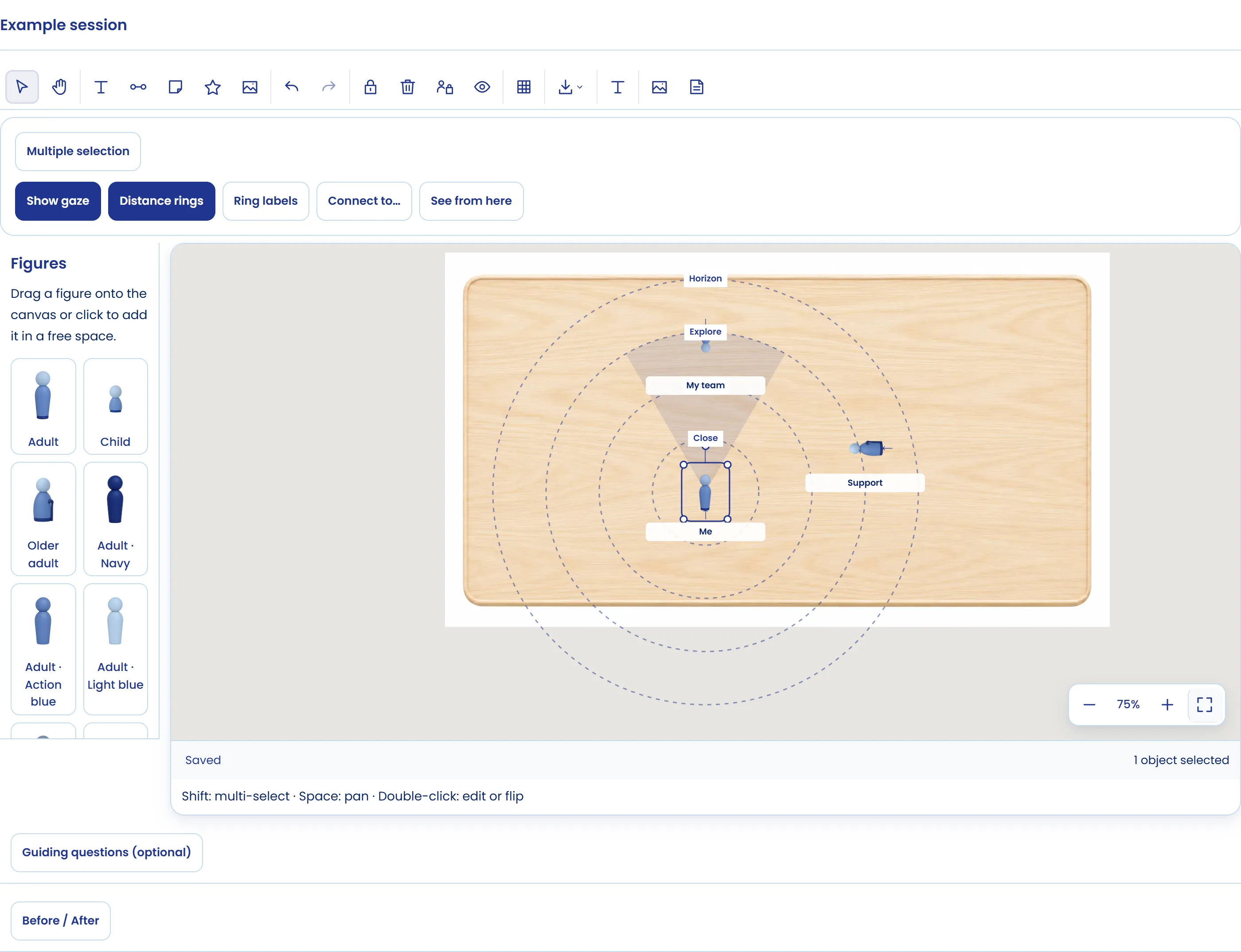
System Board: labeled distance rings and the field of view of the "Me" figure.
When a move makes sense, you save a snapshot. With Before / After you place the first picture of the system next to the latest one. The board also comes with optional guiding questions. Our systemic board online guide covers every feature with an example.
System two: the team or organization your client is part of today
The same board works for your client's team: the leader, their peers, the person who just joined, the person who left. An example: picture a director who places her team on the board and uses See from here to look at it from the new hire's position. What she sees from there usually becomes the session.
In Leadership Team Coaching (Kogan Page, 2011), Peter Hawkins makes the case for coaching a team as a whole system rather than as a collection of individuals. In Systemic Coaching: Delivering Value Beyond the Individual (Routledge, 2020), Hawkins and Eve Turner widen the lens further: coaching should create value for everyone around the client. For that work, the catalog gives you:
- Team Communication Map: a matrix of how often and how well team members communicate, turned into a visual network that exposes silos, bottlenecks and strained links.
- Belbin Team Roles Matrix: maps the nine roles and spots gaps and imbalances. More in Belbin team roles in coaching.
- Team Trust Barometer: 25 questions on trust, conflict, commitment, accountability and results.
- Team Agreements Canvas: the team's working norms in nine blocks, with commitment signatures.
- Stakeholder Map: stakeholders by power and influence, to look at the wider system around your client.
When you coach the whole team, the group video call brings together up to 10 people (you and 9 guests), and the host's notes land in the file of every client who attended. When the client is the organization itself, the Organizations module measures departments with 19 instruments, including belonging and inclusion, trust, agreements and team effectiveness, with aggregated results and comparisons between measurements. For more group work, see team coaching dynamics and tools.
System three: significant relationships
The third system is made of the relationships your client chooses, the ones that hold them up or pull at them: partner, friends, business partners, mentors.
- The Meaningful Relationship Map places each relationship in concentric rings by closeness and quality: relationships that nourish, relationships to cultivate and connections that drain.
- Boundary Architecture structures your client's boundaries like the clauses of a contract: clear, written down and with consequences.
- Inner Voices takes the system inward. Each voice has a face and something to say ("the demanding one", "the one who looks after the team"); moving it toward the center gives it more weight. You decide whether the voices are visible from the start.
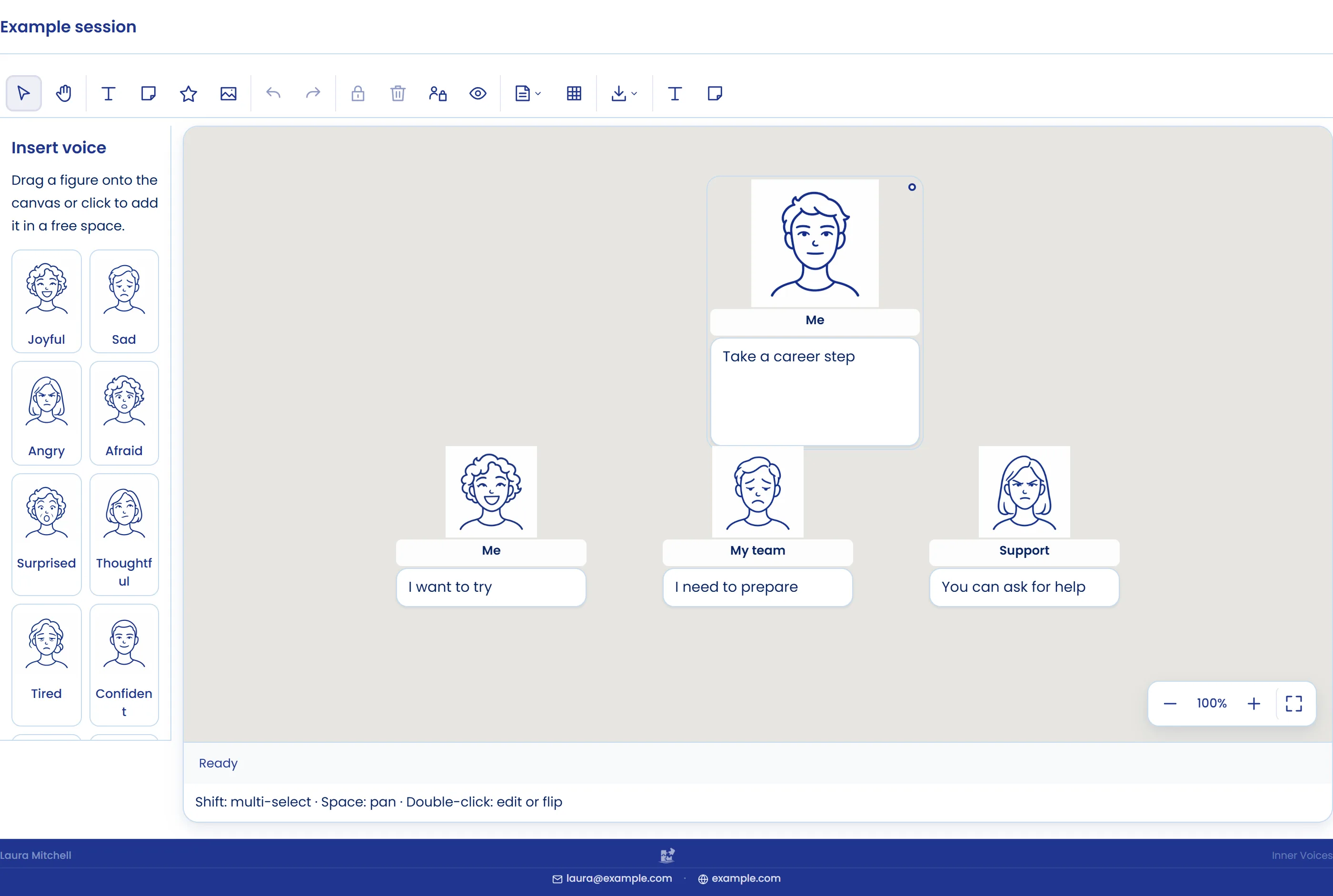
Inner Voices: each voice with its face and its line, live with the client.
The System Board works here too: your client stands in the center, turns on the rings and places the important people in their life. Relationship marks where there is a bond, tension, longing or a break.
After the session: everything lives in the client's file
Systemic work moves in layers, so nothing from the session can get lost:
- Client file: contact details, goals, notes, history and a timeline of sessions, tools and messages. With relationships between clients you link two clients from the same system, for example two members of a team you coach separately.
- Session record: goal, notes, agreements, tasks and next steps, with an AI draft from a transcript if you use it.
- Client space: your client opens it by link and sees their live tools, appointments, actions and the notes you shared. They tick off their actions and write to you in the Client Log; you reply from their file.
- Snapshots and Before / After on the board, PNG and PDF for the genogram, and PDF for the catalog tools, so you can hand over a report at the end of the process.
- Goals and actions with a starting point, a target, dates and reminders.
Scheduling, video calls, payments and your brand
Clients book from your public booking page, connected to your Google Calendar, and the session runs in the platform's 1:1 video call, where you open the board and work on it together. You charge for processes and programs through your own Stripe account, in one payment or in 1 to 60 installments, with an invoice and a contract signed electronically. If you run group programs, you build them from steps that combine tools, tasks and content. And with White Label, tools and PDFs carry your logo, your colors and your name.
Plans for systemic coaches on CoachPro Tools
The platform is the same on all three plans, with unlimited clients: Monthly at $30 USD/month, Annual at $157 USD/year or Lifetime at $297 USD as a one-time payment, yours for life. White Label is added separately. The Annual and Lifetime plans include a lifetime GoHighLevel sub-account as a bonus. You can start with a 3-day trial with a card, and you're covered by a lifetime guarantee.
Your client, their three systems and all your work on one platform
System Board, Genogram, Inner Voices, +330 tools, client files, client space, scheduling and payments.
See plans and pricing →Frequently asked questions
What systemic coaching tools does CoachPro Tools include?
The live tools System Board, Genogram and Inner Voices, plus catalog tools such as the Meaningful Relationship Map, Boundary Architecture, the Team Communication Map, the Belbin Team Roles Matrix, the Team Trust Barometer, the Team Agreements Canvas and the Stakeholder Map, among +330 tools.
Can my client move the board figures from home?
Yes. The System Board is a live tool: you and your client use it at the same time, each from your own screen, and whatever one of you moves shows up for the other instantly. The document is assigned to the client and appears in their client space.
Does my client need to install anything to use the board live?
No. You and your client use the System Board at the same time, each from your own screen: what one moves appears for the other instantly, and it is saved in the client's space.
What does See from here do?
It shows the scene from one figure's position: what is in view, who is looking at it and what is behind. That view only changes your screen, and the Notes from this figure are shared with your client.
Can I compare the system at the start and at the end of the process?
Yes. On the System Board you save snapshots, and Before / After places two of them side by side.
Does it work for systemic team and organizational coaching?
Yes. The board can represent the team, the catalog has tools for team communication, roles, trust and agreements, the group video call brings together up to 10 people and the Organizations module measures departments with 19 instruments.
Can I put my own brand on what I deliver?
Yes. With White Label, tools and PDFs carry your logo, your colors and your name.
How much does it cost and how many clients can I have?
Monthly is $30 USD/month, Annual is $157 USD/year and Lifetime is $297 USD as a one-time payment. All three include unlimited clients, a 3-day trial with a card and a lifetime guarantee.